
Comparing CNC Carbon Fiber Drone Arm Quotes Against One Drawing
Compare returned drone arm quotes by drawing revision, laminate, interfaces, finishing and inspection. Resolve exceptions before choosing a price.

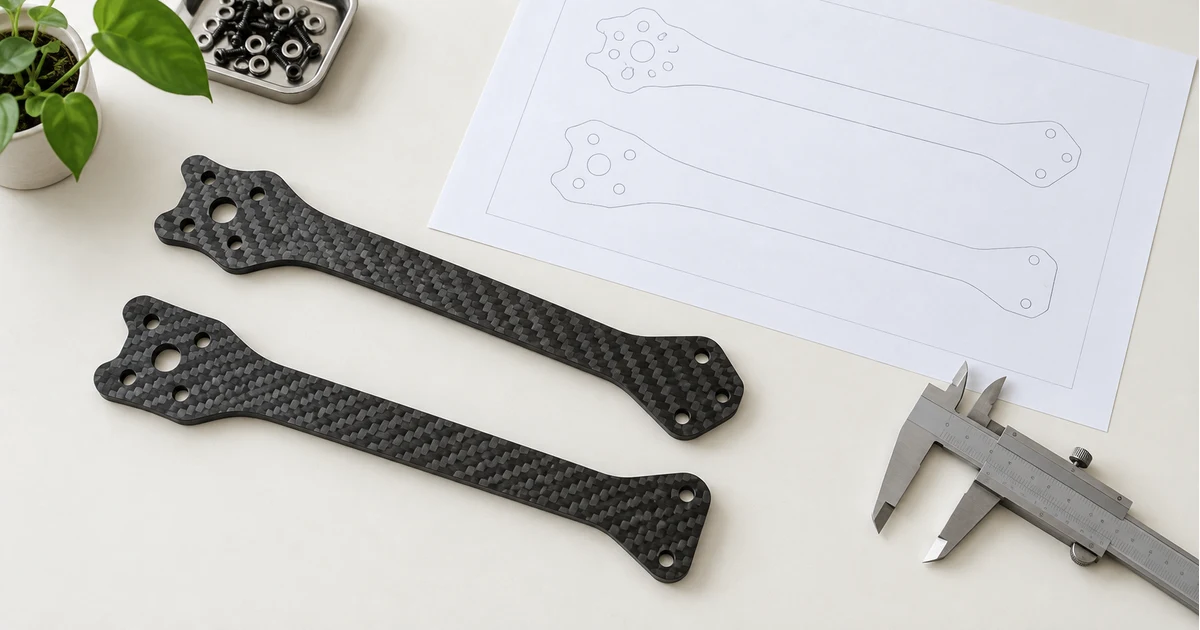
Compare CNC-cut carbon fiber drone arm quotes only after each supplier has confirmed the same drawing revision, material requirements, supplied quantity and acceptance scope. A lower price for a different laminate, an unfinished edge or an undocumented hole pattern is not yet a like-for-like offer. Mark every difference before deciding whether it is acceptable.
This guide is for buyers who already have a drawing and have received quotations for hobby or FPV arm plates. If you still need to prepare the enquiry, use the CNC drawing preparation guide. Company checks belong in the separate supplier qualification checklist. Here, the task is narrower: turn returned offers into a comparable decision record.
Key takeaways
- Keep one agreed drawing and material requirement as the comparison baseline.
- Record requirements as accepted, excepted or not stated. Silence is not confirmation.
- Resolve material, interface and inspection differences before comparing the final quoted total.
- An accepted component quote or sample does not establish flight suitability for a complete aircraft.
Freeze the baseline before comparing replies
A quotation comparison needs an identifiable baseline, not just the description “carbon fiber drone arm.” Record the part number, drawing revision, units, requested quantity and whether the enquiry covers individual arms or a complete set. Keep the geometry file and dimensioned drawing together, with a clear rule for resolving any conflict between them.
Ask each supplier to identify the files used for the quote. Do not assume that a later email attachment replaced an earlier revision in its pricing or production record. In its own part revision workflow, Xometry requires an updated drawing attachment after a CAD change and warns that changes to ordered parts may no longer be possible once work has progressed. That is an example of one provider's process, not a CFW order-change policy.
For your comparison, a quotation based on an older drawing stays unresolved until the supplier confirms the current revision. If a design change is intentional, update the baseline and ask all candidates to quote that same change.
Turn each quote into an exceptions list
An exception is a proposed departure from your requested scope. It might be a different laminate, a changed hole requirement, omitted finishing or an inspection record that is available only at extra cost. An exception is not automatically a defect or a bad offer; it must simply be visible and accepted by the right person before ordering.
Use three plain statuses for each requirement:
- Accepted: the reply explicitly confirms the requested requirement.
- Exception: the reply proposes a different requirement or excludes part of the work.
- Not stated: the reply does not establish what is included.
Keep a reference to the quotation line, attachment or written clarification beside the status. An internal note saying “probably included” is not supplier confirmation. Ask for a revised quote or written clarification rather than filling a blank with an assumption.
The CarbonCutUK services page identifies material, thickness, size, design complexity and engraving among its cutting-cost inputs. This supports a practical comparison rule: separate the requested work from the headline price. It does not establish another supplier's rates or capabilities.
Use a requirement-by-requirement comparison sheet
Start with the rows below, then replace general wording with the references in your actual drawing and enquiry. Keep technical acceptance separate from the purchasing decision. A buyer can compare evidence without independently approving a material substitution or a changed fit.
| Comparison row | What the returned quote must establish | Action if unclear or different |
|---|---|---|
| Part and revision | The same part number, drawing revision and units | Request explicit file/revision confirmation |
| Plate material | The requested laminate construction and thickness requirement, including applicable limits | Ask for the offered material definition; refer a substitution to the responsible designer |
| Motor-side interface | Acceptance of the identified hole and clearance requirements | Record the exact exception against the drawing feature |
| Frame-side interface | Acceptance of the mounting pattern and locating requirements | Resolve independently of the motor-side interface |
| Edges and visible faces | The specified edge treatment and appearance acceptance | Ask which finishing work is included and which is extra |
| Quantity and set contents | Number of individual arms, handed variants and any included hardware | Convert offers to the same bill of materials before comparing totals |
| Inspection evidence | Agreed features, sample scope and records to be supplied | Request an inspection scope, not merely “QC passed” |
| Commercial scope | Currency, setup/sample charges, packing, delivery basis, exclusions and quote validity | Obtain a revised total on the same basis |
For each supplier, add columns for status, reply reference, open question and buyer decision. Leave a row open if its answer is missing. A long quotation is not necessarily more complete; a short quotation can be sufficient when it clearly incorporates the correct controlled documents.
The CFW FPV arm plate reference is for drawing-led arm components, not a complete drone. It identifies both motor-side and frame-side interfaces as matters to confirm. A similar outer silhouette is therefore not enough to establish that two offers cover the same component.
Resolve differences before ranking prices
Compare prices only within a scope that your project has accepted. Ask the supplier to distinguish compliance with the original requirement from an optional alternative. Otherwise, an apparent saving can be the price of work or evidence that was removed from the offer.
Hypothetical comparison, not actual supplier quotations: Quote A confirms the current arm drawing, both mounting interfaces and the requested dimensional record. Quote B identifies the same outline but lists its standard hole limits and says nothing about the record. Neither the shape match nor a lower total makes Quote B equivalent. Ask B to identify the affected features, confirm the required limits and price the requested record. If B proposes an alternative, obtain the responsible designer's decision before treating the offers as comparable.
Avoid demanding tighter limits everywhere just to make a quote look rigorous. Xometry's CNC tolerance guidance explains that tighter requirements can change manufacturing and inspection effort. Its published numeric capabilities are not limits for CFW or for carbon fiber arm plates. The useful buying action is to compare the same design-defined requirements, not import another company's tolerance table.
After resolving technical differences, ask for a total covering the same quantity, included parts and delivery basis. Keep one-time charges separate from repeat-part charges. Where currencies differ, record the exchange-rate source and date used internally; do not silently combine totals on different bases. Quote validity and the condition that starts the stated lead time also need to be explicit.
Carry the accepted scope into sample approval
The comparison is complete when the selected quote, drawing and accepted exceptions describe the same order. Save those documents together and identify who approved each departure. Do not replace a written approval with a memory of a call.
Before sample work begins, agree which features will be checked and what evidence will accompany the sample. The specification and inspection planning guide distinguishes an order requirement from an actual inspection result. A promised record is not a completed measurement, and a sample photo is not proof of a specified dimensional limit.
When a sample arrives, match its reference and reported revision to the accepted documents. Any discrepancy should return to the exception list for resolution. Keep component dimensional acceptance separate from complete-system design validation: this article does not provide load limits, flight approval or a test procedure.
Request a comparable CFW quotation
For a CFW arm plate enquiry, include reference CFW-3298, the drawing revision, material request, quantity, set contents and the inspection records you need. Ask the response to identify exclusions or proposed alternatives separately. Confirm achievable requirements, timing and supply scope in the quotation; do not infer them from the illustration or another supplier's website.
Request a quote for CFW-3298 with your drawing and comparison questions. The goal is a traceable purchasing decision: one accepted baseline, explicit exceptions and a price attached to that agreed scope.
Editorial note: Source-informed, AI-assisted purchasing guidance published by CarbonFiberWorld through its support account. External provider documentation was checked on 20 September 2026 and illustrates quotation practice, not CFW certification or an endorsement. No first-hand machining test or named engineering review is claimed. See company and contact information for editorial ownership and corrections.