
Aircraft Composite Recycling: End-of-Life Carbon Fiber Guide

Quick Answer: Aircraft composite recycling turns end-of-life carbon-fiber structures into traceable material streams for new aerospace or industrial products. The practical sequence is reuse first, then careful disassembly, material identification, separation, fiber recovery and application-specific qualification. Recovered carbon fiber can reduce waste and virgin-material demand, but it is not automatically approved for flight-critical parts.
What Is Aircraft Composite Recycling?
Modern aircraft contain metals, polymers, honeycomb panels, adhesives and increasing amounts of carbon-fiber-reinforced polymer (CFRP). At retirement, serviceable components may be reused with valid records, while non-reusable structures are dismantled and routed to recycling, upcycling, energy recovery or disposal.
Aircraft composite recycling focuses on preserving the highest practical value. A clean, documented prepreg offcut is easier to recover than a painted sandwich panel containing adhesive, core, inserts and contamination. The quality of sorting and disassembly often determines the quality of the recovered material.
Why End-of-Life Aircraft Composites Are Challenging
- Mixed construction: laminates may be bonded to aluminum, titanium, foam or honeycomb core.
- Thermoset matrices: cured epoxy cannot be remelted like a conventional thermoplastic.
- Contamination: paint, sealant, oil and service residues complicate processing.
- Traceability: aerospace reuse depends on material identity, records and controlled handling.
- Certification: recovered material needs evidence appropriate to its new function.
The Aircraft End-of-Life Value Hierarchy
| Route | What is preserved? | Typical destination |
|---|---|---|
| Component reuse | Original form and function | Approved spare or serviceable assembly |
| Repurposing | Part or section | Training, fixtures, furniture or display |
| Material upcycling | High-value material properties | New aerospace or advanced-manufacturing parts |
| Material recycling | Fiber, metal or polymer feedstock | Molding compound, sheet or industrial product |
| Energy recovery/disposal | Little material value | Last-resort waste route |
Aircraft Composite Recycling Process
- Asset assessment: decide which components remain serviceable and which are waste.
- Record capture: preserve part history, material data and dismantling information.
- Safe disassembly: remove hazardous materials, fluids, batteries and reusable equipment.
- Material profiling: identify fiber, resin, core, coatings, inserts and contamination.
- Multi-material separation: isolate CFRP from metals, honeycomb and other bonded layers.
- Recovery: use mechanical, thermal or chemical processing suited to the feedstock.
- Conditioning: clean, size, align or compound the recovered reinforcement.
- Qualification: test the material and finished part for the intended application.
How Carbon Fiber Can Be Recovered
Mechanical Recycling
Cutting and milling produce short-fiber-rich recyclate. It is comparatively simple, but fiber length and alignment are reduced. The output often suits compression-molding or injection-molding compounds.
Thermal Recycling
Pyrolysis removes polymer in a controlled low-oxygen environment. Process temperature and oxidation control affect fiber cleanliness, surface condition and strength retention.
Chemical Recycling
Solvolysis uses reactive fluids to break down the resin and release fiber. It can support cleaner recovery and resin-derived products, but requires chemical or water management, pressure equipment and energy integration. See our guide to CFRP chemical recycling.
Nandina REM and A*STAR Aviation Circularity Work
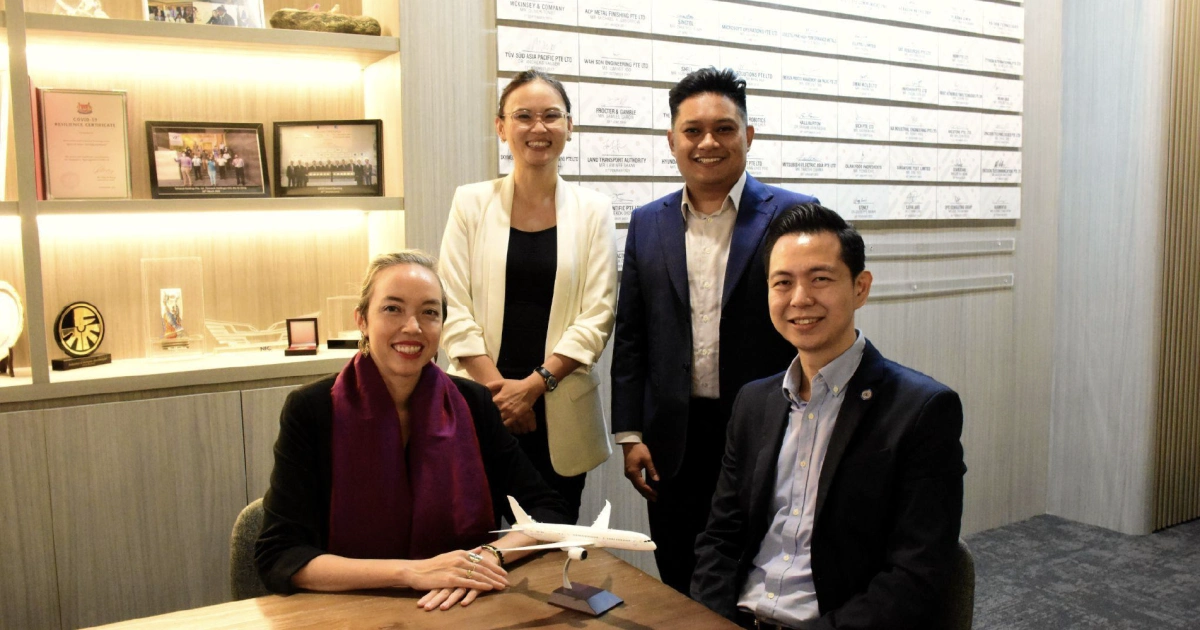
In February 2024, Singapore’s Agency for Science, Technology and Research (A*STAR) announced a partnership with Nandina REM to develop routes for reclaiming high-quality carbon fiber from end-of-life aircraft. The program emphasizes component profiling, intelligent disassembly, multi-material segregation, green recovery and end-to-end traceability.
A*STAR described potential destinations including aircraft cabin galleys and seats as well as electric-vehicle battery casings. These are proposed or developing value chains; any claim that recovered material is “aviation grade” should be supported by a defined specification, test method, lot data and approval pathway.
Separation Is as Important as Fiber Recovery
An aircraft panel may combine carbon-fiber skins, honeycomb core, film adhesive, edge potting, fasteners and surface coatings. A*STAR researchers have reported a sonochemical separation approach using power ultrasonics and mild chemicals to separate carbon-fiber sheets from honeycomb structures before subsequent fiber recovery.
Better separation can produce cleaner, more homogeneous feedstock. It may also allow each material stream to enter its best-value route instead of contaminating the entire batch. The environmental case also depends on recovery energy and the displaced material; our carbon fiber lifecycle guide explains how to compare those boundaries.
Can Recycled Carbon Fiber Return to an Aircraft?
Potentially, but the application defines the evidence. Reusing a certified component, manufacturing a cabin interior panel and producing a primary load-bearing structure are three very different approval cases. Recovered fiber should not be described as a drop-in replacement for virgin continuous fiber without representative testing and authority acceptance.
| Application | Important evidence |
|---|---|
| Cabin or non-structural panel | Fire, smoke, toxicity, durability and dimensional control |
| Bracket or equipment housing | Strength, stiffness, impact, environment and inserts |
| Conductive industrial part | Electrical performance, dispersion and aging |
| Flight-critical structure | Full material allowables, fatigue, damage tolerance and certification |
Quality and Traceability Checklist
- Identify aircraft source, component and service history where available.
- Record resin family, fiber form, coatings, core and embedded metals.
- Define contamination and moisture limits.
- Measure recovered-fiber length, residual resin and surface condition.
- Test tensile properties and composite coupons from each qualified process window.
- Control sizing and compatibility with the new matrix.
- Maintain batch genealogy from dismantling through finished material.
- Quantify yield, energy, emissions and residual waste with a stated boundary.
Designing New Parts for Circularity
Circularity improves when engineers plan for disassembly at the design stage. Accessible fasteners, documented materials, separable layers and fewer incompatible adhesives can make future recovery easier. Thermoplastic matrices may support remelting or reforming in some designs, while modular architecture helps retain component value.
For a new OEM program, start with geometry, loads, environment and annual volume. Our custom carbon fiber components, carbon fiber sheets and CNC carbon fiber parts pages outline practical manufacturing choices.
Questions to Ask a Recycling Partner
- Which aircraft composite constructions can you accept?
- How do you separate metal, adhesive, paint and core?
- What usable-material yield is achieved—not just diversion by mass?
- Which properties are measured for every lot?
- How is recovered fiber sized and supplied?
- What evidence supports emissions or cost claims?
- What applications have completed qualification?
- How are rejected materials and liquid or gaseous by-products handled?
Frequently Asked Questions
What happens to a retired aircraft?
Serviceable components may be reused with appropriate records. Remaining structures are dismantled into material streams for recycling, upcycling, energy recovery or disposal.
Why not melt CFRP?
Most legacy aircraft CFRP uses cross-linked thermoset resin, which does not melt after curing. The resin must be mechanically, thermally or chemically removed or transformed.
Is recycled aircraft carbon fiber lower quality?
Quality depends on feedstock and process. Fiber may retain valuable properties, but length, alignment, surface and consistency determine the achievable part performance.
What is the best recycling method?
There is no universal best method. Selection depends on composite construction, contamination, required output, local infrastructure, energy and economics.
Does near-zero landfill mean full circularity?
No. Diversion is useful, but circularity also considers retained value, actual displacement of virgin material, energy, emissions and residual streams.
Authoritative Sources
Primary program source: Nandina REM’s announcement of its collaboration with A*STAR. Regulatory lifecycle context: EASA guidance on aircraft end-of-life sustainability.
Specific performance and emissions figures require validation against the relevant process boundary, material lot and application standard.