
Carbon Fiber Sheet Flatness: Agree the Support Condition

Before comparing a carbon fiber sheet flatness result, agree the inspection condition: which face and area are controlled, how the sheet is oriented and supported, and whether restraint is applied. A result belongs to that identified condition. When two records use different or undocumented states, clarify the difference before treating them as equivalent evidence.
This guide helps engineering buyers and receiving teams prepare that agreement. It sets no CFW flatness tolerance and reports no measurements.
Separate receiving, inspection and installation
Keep these records distinct. The parties decide which conditions the order needs; the examples below do not require three tests.
| Record | What the record should identify |
|---|---|
| Receiving observation | The sheet as received, its position and contacts, and any visible condition. A photograph carries no unrecorded numerical acceptance result. |
| Agreed inspection condition | The controlled face and area, orientation, supports, any specified restraint, method and acceptance criterion. |
| Installed-fit review | The identified assembly, mounting arrangement and fit question. Its result applies to that configuration. |
An installed-fit review can answer an assembly question while leaving a separately specified sheet requirement unresolved. For structural thickness selection, use the sheet-thickness guide; the decision here concerns the conditions attached to acceptance evidence.
Define the support condition before comparing results
KEYENCE America’s non-rigid-part education explains free-state conditions and the relevance of orientation, including gravity direction. Its examples also distinguish requirements under restraint. This educational source does not classify a CFW sheet as non-rigid or prescribe its inspection setup.
For the proposed order, identify the sheet face, controlled area and orientation. Use a referenced sketch to locate supports and contact areas. Name any required restraint and its method; include locations or other settings when the responsible parties specify them. Do not leave the reader to infer the setup from an unlabelled photograph.
Our procurement rule is to check state equivalence before comparing results. A missing support or restraint description is a clarification item, not permission to assume that both records used the same condition.
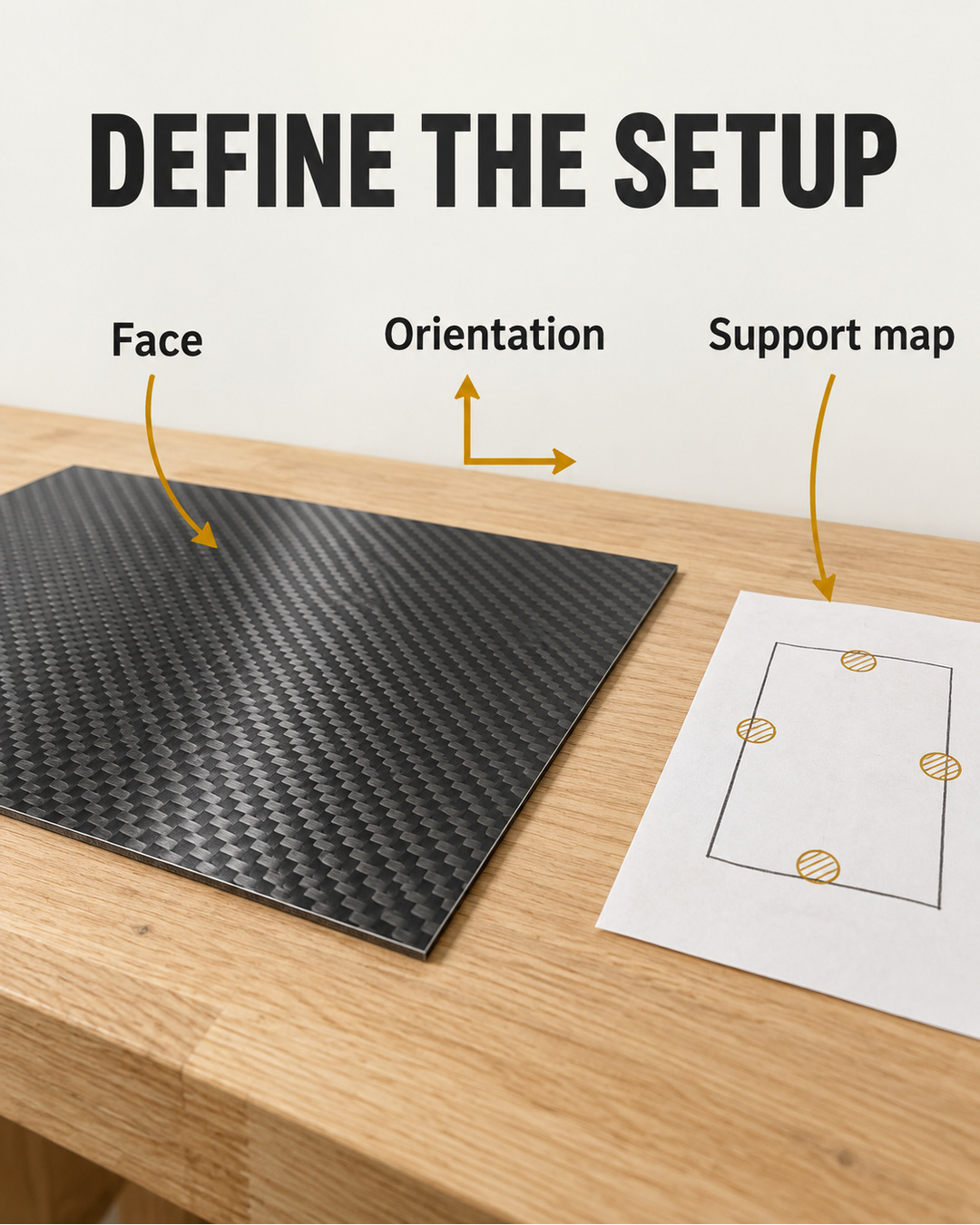
Keep visual screening separate from acceptance
Record what was observed, the sheet identity and the conditions. If the order calls for a geometric result, agree its criterion and measurement basis separately. A thickness reading, a visual observation and an installed-fit result answer different questions. Pressing a panel flat does not establish its condition without that restraint.
Use one seven-field acceptance record
Copy this blank planning record into the enquiry. Complete it with agreed requirements and actual evidence. Unanswered fields stay open.
- 1. Identity and revision
- Part, sheet, sample or batch reference; drawing and specification revision.
- 2. Controlled face, area and orientation
- Which face and region the requirement covers, and how the sheet is oriented.
- 3. Support map
- Support/contact locations and the referenced setup sketch or configuration.
- 4. Restraint condition
- No added restraint or the specified fixture arrangement; agreed method and relevant settings.
- 5. Acceptance criterion
- The agreed requirement, units and condition to which it applies; unresolved limits remain unagreed.
- 6. Measurement and evidence scope
- Agreed method, coverage and sample scope; instrument or report references where provided.
- 7. Result, decision and owner
- Actual results in the agreed format, comparison decision, open action and responsible approval reference.
This is an original procurement record, not a completed inspection report or a prescribed standard procedure.

Clarify a mismatch before release
Consider a hypothetical pair of records for the same sheet revision. One shows a receiving observation; the other reports a result with a fixture applied. Keep both, but first ask whether either matches the agreed acceptance condition and whether they cover the same face and area.
If the basis differs or is missing, record the comparison as unresolved. Agree who will clarify the method or obtain matching-condition evidence before release. Do not turn the difference into an automatic acceptance or rejection. A changed support or restraint arrangement should remain visible in the record. For broader repeat-order changes, use the dimensions and surface-finish reorder guide.

Prepare the CFW sheet enquiry
The current 400 × 500 × 2.0 mm sheet listing provides a nominal product reference, with surface and tolerances set by the agreed order specification. Use CFW-3141 as the enquiry reference. That listing does not establish a measured flatness result or a particular inspection service.
Send the required panel dimensions, drawing revision, quantity, intended application and destination, together with the proposed acceptance record. Identify requirements separately from suggested methods and open questions. Ask CFW to confirm the offered supply and documentation scope before relying on it.
Request a CFW-3141 quotation with your support-condition requirements. Identify any supporting drawings in the message and agree how to provide them.
Product and source information checked October 31, 2026. The record and hypothetical example are original editorial synthesis, with no first-party measurement results or project-specific engineering approval.